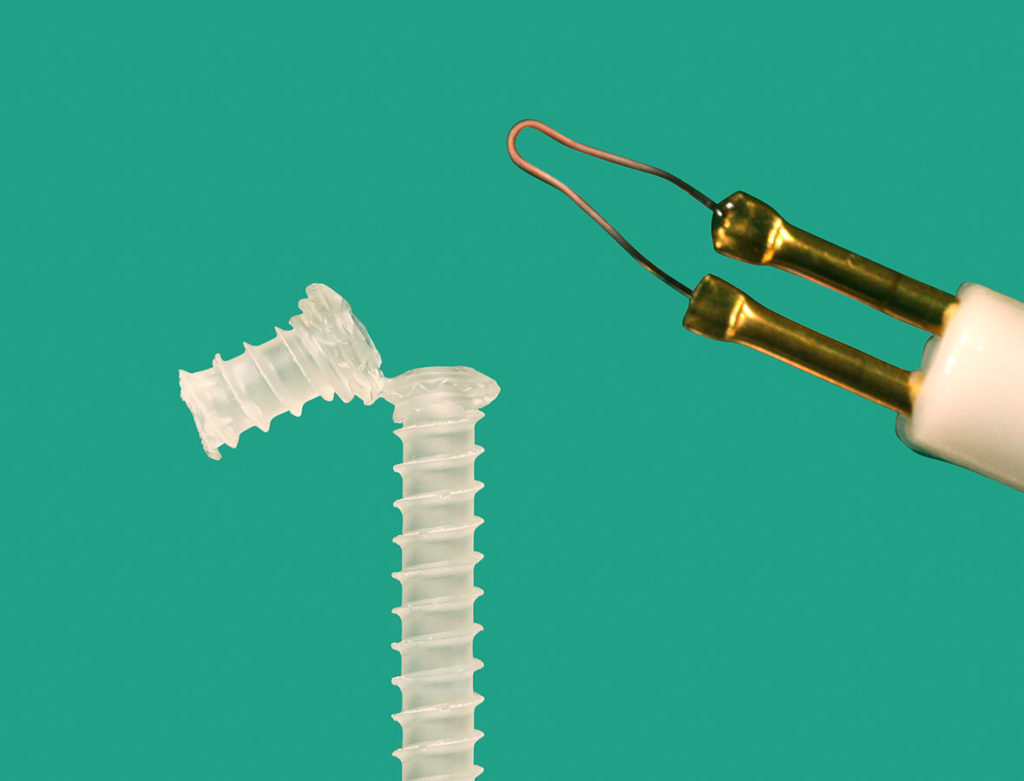

Clinical evidence published in the study Three-dimensional printed screw guide-assisted metatarsal osteotomy for the treatment of mild-to-moderate hallux valgus, demonstrates that three-dimensional (3D) printed screw guide-assisted percutaneous metatarsal transverse osteotomy (PMTO) is a safe, effective and efficient technique for the treatment of mild-to-moderate hallux valgus. The study, published in the Journal of Orthopaedic Surgery and Research, reports excellent clinical and radiographic outcomes using bioabsorbable FreedomScrew™ screws for fixation, supporting their use in minimally invasive forefoot surgery.
How Inion FreedomScrew™ implants were used
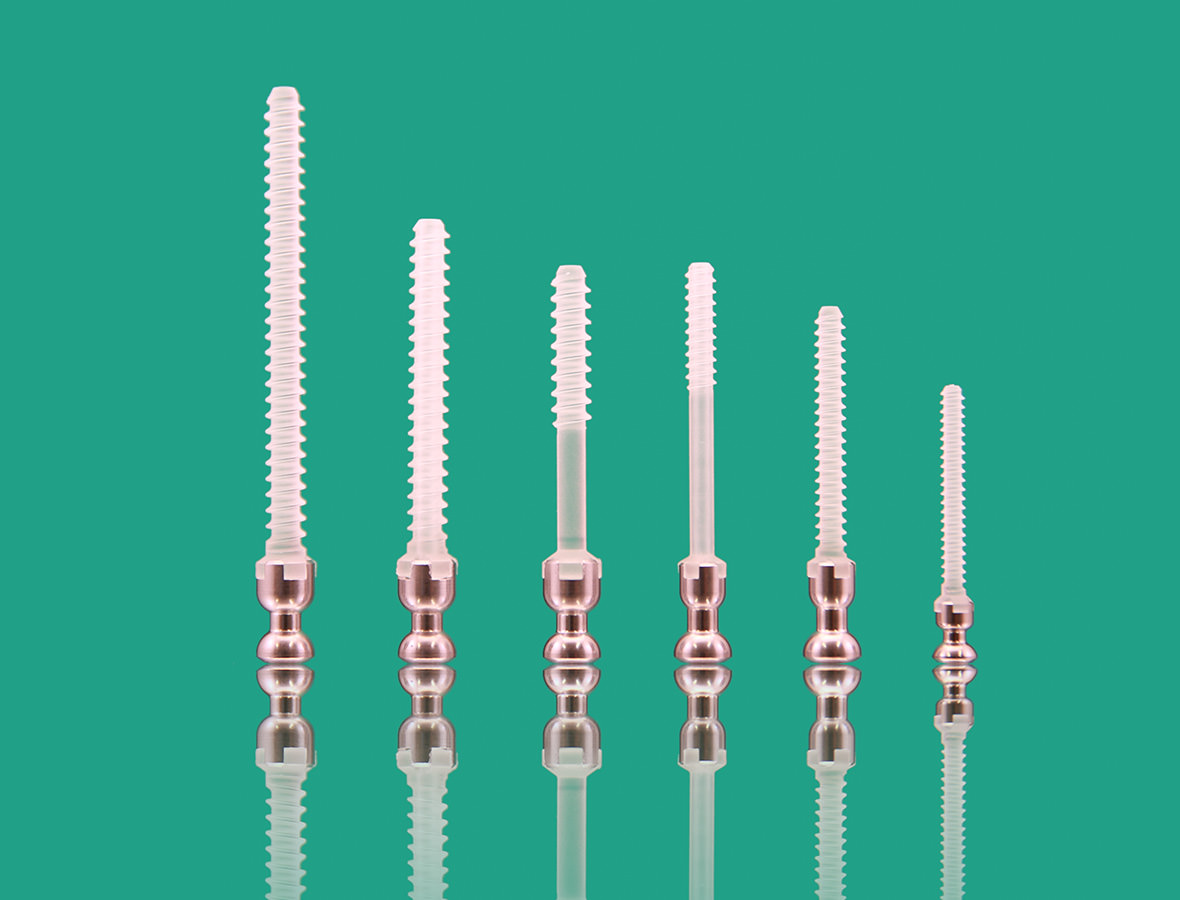
The authors used Inion bioabsorbable FreedomScrew™ screws for fixation following minimally invasive metatarsal osteotomy:
- 4.5 mm screw for fixation of the first metatarsal osteotomy
- 2.7 mm screw for Akin osteotomy when required
The bioabsorbable fixation was combined with patient-specific 3D-printed screw guides to improve surgical accuracy and facilitate minimally invasive correction.
Key clinical results
The study demonstrated significant improvements in both radiographic correction and patient-reported outcomes following treatment. The mean Hallux Valgus Angle (HVA) improved from 32.2° preoperatively to 11.2° at the final follow-up, while the Intermetatarsal Angle (IMA) decreased from 12.6° to 8.1°, indicating successful correction of the deformity. Functional outcomes also improved substantially, with the average AOFAS Forefoot Score increasing from 59.7 to 89.8 and patients reporting a marked reduction in pain, as measured by the Visual Analogue Scale (VAS), from 6.1 to 0.7. The average operative time was 41 minutes, and mean first metatarsal shortening was limited to 3.2 mm. Importantly, no cases of non-union, metatarsal head necrosis or deformity recurrence were observed during the average 24-month follow-up period. Only minor, transient complications were reported, supporting the safety and reliability of the technique.
The paper was published in the Journal of Orthopaedic Surgery and Research, and is authored by Wang J, Fu S, Wang C, Zhang S, Shi Z and Ma X. (2025).
Author’s conclusion
The authors concluded that combining patient-specific 3D-printed screw guides with Inion bioabsorbable FreedomScrew™ screw fixation provides a safe, accurate and effective approach for the treatment of mild-to-moderate hallux valgus. The technique was shown to facilitate precise screw placement, reduce operative time and achieve reliable deformity correction while delivering excellent functional recovery. Based on their findings, the authors consider this approach to be an efficient and reproducible minimally invasive technique that offers promising clinical outcomes and a favorable safety profile.