

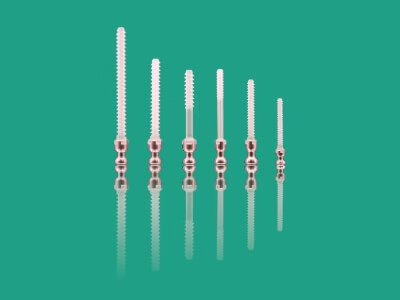
The recent study by Jie Chen, Zhen Yin, Weibo Zhou, Wen Tan, Jiayi Ma, and Fulin Zhou (2025) discusses the clinical efficacy of posterior ankle arthroscopy with absorbable screws in treating posterior malleolus fractures (PMFs). The paper concludes that posterior ankle arthroscopic reduction and fixation for treatment of PMFs with absorbable screws enables direct visualization of articular surface reduction and fixation, avoiding secondary removal of internal fixation and reinjury of soft tissues. According to the findings, good ankle joint function can be obtained through soft tissue protection and precise reduction, indicating this scheme is an optional surgical method. Bioabsorbable Inion FreedomScrews™ were used in the study.
Posterior ankle arthroscopic reduction and fixation for treatment of posterior malleolus fractures with absorbable screws
Jie Chen, Zhen Yin, Weibo Zhou, Wen Tan, Jiayi Ma, Fulin Zhou, Foot and Ankle Surgery, 2025, ISSN 1268-7731. https://doi.org/10.1016/j.fas.2025.12.004.
Abstract
Purpose
To explore the clinical efficacy of posterior ankle arthroscopy with absorbable screws in treating posterior malleolus fractures (PMFs).
Methods
The data of 33 patients who underwent posterior ankle arthroscopy with absorbable screws for the treatment of PMFs between January 2022 and December 2023 were retrospectively analyzed. The surgical time, postoperative secondary injuries and soft tissue complications were recorded. The articular surface reduction quality and syndesmotic congruence were observed under X-ray and 3D CT. At the last follow-up, the ankle joint flexion mobility and occurrence of toe flexion contracture were recorded. Pains were assessed using Visual Analogue Scale (VAS). Functional efficacy was evaluated using American Orthopeadic Foot and Ankle Society (AOFAS) score, and Olerud-Molander Ankle Score (OMAS).
Results
No secondary injuries or complications occurred postoperatively. The reduction of articular surface and the syndesmotic congruence were good. The fractures had no reduction loss and were all healed on time. At the last follow-up, the ankle joint flexion mobility was excellent, and there was no complication of toe flexion contracture. The VAS scores were 0.67 ± 0.92, the AOFAS scores were 92.73 ± 6.77, and the OMAS scores were 94.84 ± 7.01.
Conclusions
Posterior ankle arthroscopic reduction and fixation for treatment of PMFs with absorbable screws enables direct visualization of articular surface reduction and fixation, avoiding secondary removal of internal fixation and reinjury of soft tissues. Good ankle joint functions can be obtained through soft tissue protection and precise reduction, indicating this scheme is an optional surgical method.
Clinical evidence
Since 2001, Inion® implants have been used in over 300,000 surgical procedures. Several scientific publications demonstrate the safety and efficacy of the Inion® implants. We have collected evidence-based pre-clinical and clinical references, in vitro and biomechanical studies as well as literature reviews mentioning the application of Inion® products in published peer-reviewed journals on our Clinical evidence page. These references provide healthcare professionals with valuable insights to enhance their understanding of the clinical outcomes associated with Inion® products